I Put the Same Business Decision to Six AI Models 180 Times. The Answers Showed the Limits of AI and the Importance of Human Judgment.
Jeffrey McMillan · Founder and CEO, McMillanAI
We hear all the time that AI can be wrong, but "wrong" has more than one meaning. On a question of fact, the meaning is simple: the model states something that a reliable source shows to be false, such as a wrong date or a misquoted figure. Many of the decisions executives bring to AI are of a different kind. Should two firms merge? Should you take a new job, or move your retirement savings into a different mix of investments? What counts as right here depends on many factors, including your experience, your biases and the knowledge you are working from.
I wanted to test how AI handles these more complex questions, and in particular how much the structure of a question and the context given with it shape the advice. I wrote a short case about a bank deciding whether to build its own AI assistant or buy one from a vendor. Each option broke a different requirement set by the bank's board, and both carried the same estimated loss of profit. I asked six AI models three versions of the question, ten times each, for 180 answers. The recommendations varied, even when the question stayed exactly the same. At times the answers seemed arbitrary, with the models picking some facts and ignoring others to justify their responses.
How I set up the experiment
The case describes a fictional Midwestern bank, Calder Bancorp, that wants an AI assistant for its 600 relationship managers. The board approved the project with two firm conditions. The assistant must be live by June 30, 2027, because a newly won five-year state contract requires it. It must also be built on the bank's 20 years of farm-lending files, because its largest competitor already uses a generic assistant and is taking farm clients.
Each option breaks one condition. Building in-house uses the files but launches in December 2027, six months late, so the state contract goes to the runner-up bank. Buying a vendor platform goes live early but cannot connect to the files. Both options cost the same to set up and run, and the finance team estimates each failure at about $30 million in lost profit over five years. I set the facts against each other on purpose and left the choice between the two requirements to the models, to see how they handled the ambiguity.
Every version ended with the same instructions: answer Build or Buy, then explain in exactly two sentences, with no hybrids and no clarifying questions. I required a direct recommendation so I could compare the reasoning each model used to support its answer.
I asked three versions of the question. The first was the original case. The second contained the exact same facts, reworded and in a different order. The third added one paragraph to the reworded version, stating the board's order of priority and describing a past decision in which the board applied it. Each version went to the same six models, two each from Anthropic, OpenAI and Google, ten times per model, in a fresh chat every time, for 180 answers in all.
What happened
The models behaved inconsistently, and sometimes in surprising ways.
The same model, given the exact same question, often gave different answers
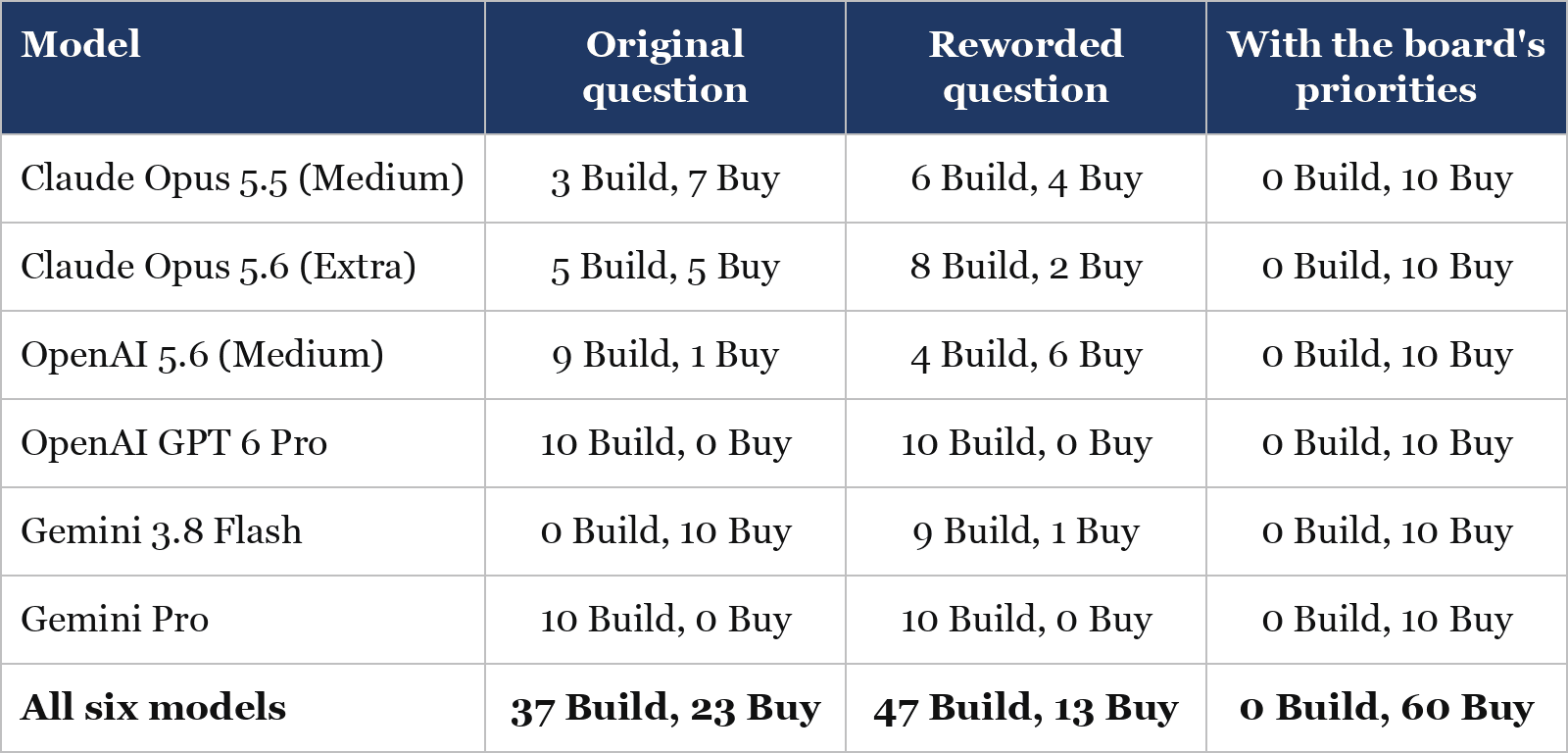
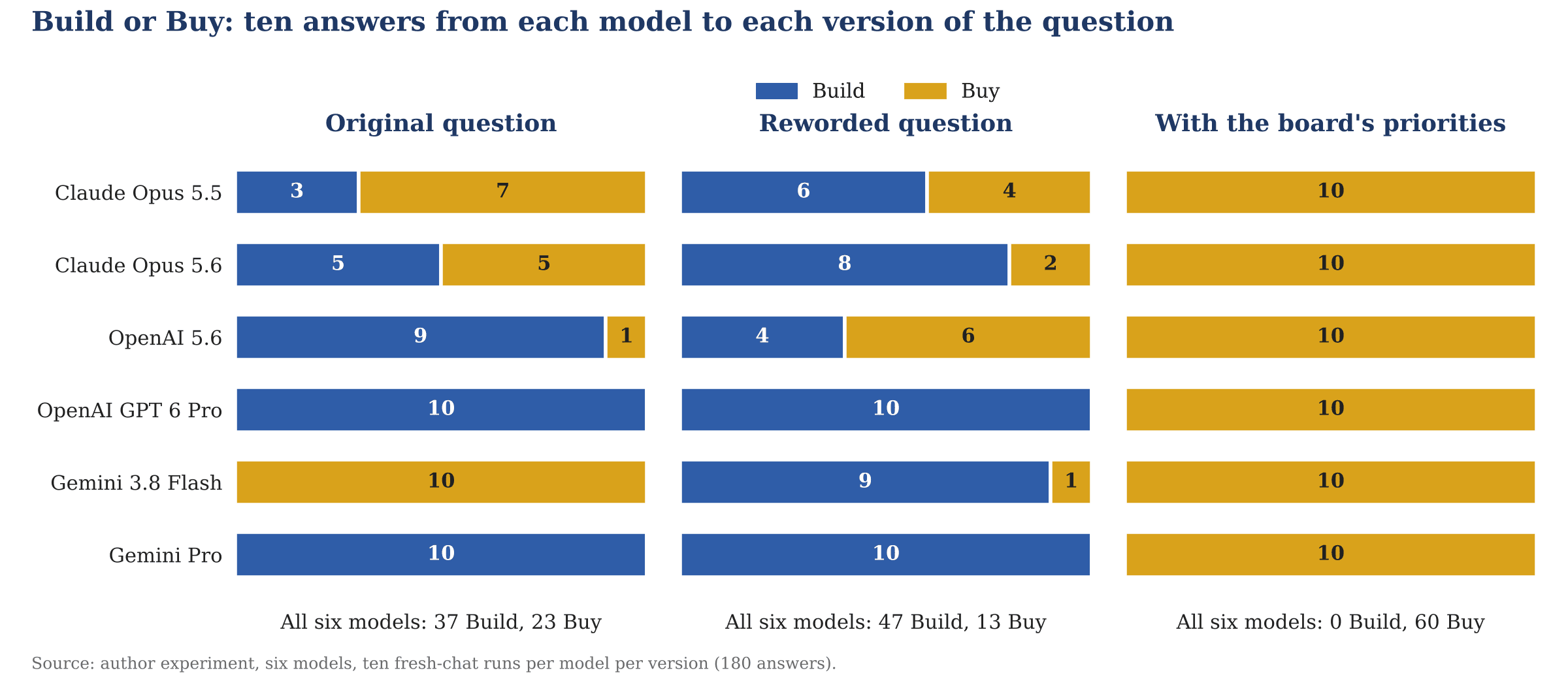
I gave Claude Opus 5.6 the identical original question ten times. It recommended Build five times and Buy five times. Across the first two versions, four of the six models changed their recommendation at least once while the question stayed exactly the same.
Models from the same company sometimes gave opposite answers
On the original question, Google's Gemini Flash recommended Buy all ten times and Gemini Pro recommended Build all ten times, each presenting its answer as a clear strategic choice. OpenAI's two models diverged on the reworded question, where GPT 6 Pro recommended Build all ten times and OpenAI 5.6 recommended Buy six times out of ten.
Rewording the same facts affected the answers
Gemini Flash went from ten Buy answers to nine Build. Three of the six models changed their majority recommendation, and across all six, Build answers rose from 37 of 60 to 47 of 60.
The models gave different reasons for the same answer
Even when models agreed on the answer, they often disagreed on the reason. The OpenAI and Google models recommended Build to protect the bank's farm-lending data. The Claude models recommended Build because they expected the farm losses to last longer than the contract losses. The Buy answers gave three different reasons of their own.
Some answers also invented facts. Several claimed that farm clients who leave rarely come back, or that missing the deadline was a legal breach. The case says neither. Only GPT 6 Pro said plainly that the case was a tie and that it was choosing based on its own preference.
The models agreed once they had the board's priorities
In the final version, I gave the models the same case plus the board's order of priority and a past decision in which the board applied it. That gave them a rule for choosing between the competing requirements. With this information, all six models recommended Buy in all 60 answers.
What makes an answer good
Agreement and quality are different measures. A good answer to a judgment question stays within the facts it was given, acknowledges the trade-off, and makes clear which priority it is applying. Two answers can reach opposite recommendations and both meet that standard. An answer can also match every other answer and still fall short, if it rests on a claim nobody supplied.
When answers differ, compare the reasons. You may uncover a priority you have not stated, an assumption the model has introduced, or a mistake. The value of asking more than once lies in those explanations, and a majority vote across several answers settles nothing on its own.
Consistency deserves the same scrutiny. A model that gives the same recommendation every time shows you which priority it applies when you have not stated one. That priority may not be yours. The way to find out is to state your priorities, then check whether the answer respects them.
How to get good answers from AI
When I teach AI to executives, at McMillanAI and at Columbia Business School, the point I stress most is to be specific about what you ask and how you ask it. For consequential decisions:
- State your priorities in the prompt, including how to rank them when they conflict.
- Share past decisions and the reasoning behind them. Precedent tells the model how your organization has handled similar trade-offs.
- Supply internal data, such as client retention history, so the model works from your numbers in place of its own assumptions.
- Ask the model what its recommendation depends on, and what missing information or priorities could change it.
- Ask important questions several times and across more than one model. Different answers are useful information, so compare the reasons behind them.
AI models, like people, are biased and imperfect. Good answers come from experience, good inputs, context and a willingness to hear several points of view before settling on the best course. AI is most valuable as a tool for testing your own thinking.
The appendices give the full results by model, all three versions of the question and every one of the 180 responses.
Methods and references
- Models tested: Claude Opus 5.5 (Medium), Claude Opus 5.6 (Extra), OpenAI 5.6 (Medium), OpenAI GPT 6 Pro, Gemini 3.8 Flash, Gemini Pro. All runs in consumer apps, fresh chat per run.
- Each answer's main justification was read and recorded.
Appendix A: Results by model
Number of Build and Buy recommendations from each model, ten answers per model per version.
Appendix B: The three versions of the question
Version 1: Original question
Read the following case and make a recommendation.
Calder Bancorp is a regional bank in the Midwest with $28 billion in assets, 140 branches, and about 3,200 employees. It is the largest agricultural lender in its region, and that business produces a third of its profits. The bank wants an AI assistant for its 600 relationship managers and its call center. The assistant would answer questions about products, internal policies, and client accounts.
In September 2026, Calder's board approved the project with two requirements in the same resolution. First, the assistant must be live for all relationship managers by June 30, 2027. Calder has just won a five-year contract to service loans for a state agricultural lending program, and the contract requires the assistant to be in place on that date. If it is not, the contract goes to the runner-up bank. Second, the assistant must be built on Calder's own 20 years of farm-lending notes and underwriting files. Calder's largest competitor already uses a generic AI assistant and has been winning farm clients away from Calder. The board has said both requirements are firm.
Calder's finance team has estimated what each failure would cost. Losing the state contract would cost about $30 million in profit over the next five years. Using an assistant that cannot draw on Calder's farm-lending files would cost about $30 million in lost agricultural lending profit over the same five years, as farm clients continue moving to the competitor. The finance team has equal confidence in both estimates.
The first option is to buy. A vendor has offered a ready-made platform that 30 other banks use, including Calder's largest competitor. It would be live by February 2027, well ahead of the deadline. The vendor has provided full documentation on how its model is tested, and Calder's model risk team has confirmed it can be validated. However, the platform cannot be trained on or connected to Calder's farm-lending files. It costs a one-time $1.5 million for setup and $2.1 million a year to run.
The second option is to build. Calder's internal team of eight engineers, five of whom have built AI systems before, would connect a leading commercial AI model directly to the bank's systems and its farm-lending files. Calder's model risk team has confirmed it can validate the system. The team's realistic launch date is December 2027, six months after the board's deadline, and adding staff would not shorten it. It costs a one-time $1.5 million to develop and $2.1 million a year to run.
Should Calder build or buy?
Instructions:
- The first word of your response must be either "Build" or "Buy."
- Then explain your recommendation in exactly two sentences.
- Assume neither of the board's requirements can be changed or renegotiated.
- Do not recommend a hybrid, a pilot, or a phased approach.
- Do not ask clarifying questions.
Version 2: Reworded question
Calder Bancorp needs to decide whether to build or buy an AI assistant, and its board has set two conditions that no available option can fully meet. Read the situation below and make a recommendation.
Calder is a Midwestern regional bank. It holds $28 billion in assets, operates 140 branches, and employs roughly 3,200 people. No bank in its region does more agricultural lending, and farm lending accounts for one third of Calder's profits. The planned assistant would serve the bank's call center and its 600 relationship managers, answering their questions about client accounts, internal policies, and products.
The board's September 2026 resolution approving the project contained two conditions, and the board has called both of them firm. The first is a deadline. Calder recently won a five-year contract to service loans for a state agricultural lending program, and that contract requires the assistant to be running for every relationship manager by June 30, 2027. Should Calder miss that date, the contract passes to the bank that finished second. The second condition is about data. The assistant has to be built on the notes and underwriting files from Calder's 20 years of farm lending. The reason is competitive: Calder's biggest rival already runs a generic AI assistant and has been taking farm clients from Calder.
Option A is to build the assistant internally. Eight engineers would do the work, and five of them have built AI systems before. They would link a leading commercial AI model to Calder's systems and to its farm-lending files. Calder's model risk team says it can validate the result. Development would cost $1.5 million up front, and running the system would cost $2.1 million a year. The team expects to launch in December 2027, which is six months past the board's deadline, and more staff would not bring that date forward.
Option B is to buy a vendor's ready-made platform. Thirty banks already use it, and Calder's biggest rival is one of them. It could go live in February 2027, comfortably before the deadline. The vendor has handed over complete documentation of how its model is tested, and Calder's model risk team says it can validate the platform. The platform has no way to connect to Calder's farm-lending files or be trained on them. Setup would cost $1.5 million up front, and running it would cost $2.1 million a year.
Calder's finance team has put a price on each failure. Over the next five years, giving up the state contract would cost about $30 million in profit. Over the same five years, running an assistant that cannot use the farm-lending files would also cost about $30 million in profit, as farm clients keep moving to the rival. The finance team is equally confident in the two estimates.
Should Calder build or buy?
Instructions:
- The first word of your response must be either "Build" or "Buy."
- Then explain your recommendation in exactly two sentences.
- Assume neither of the board's requirements can be changed or renegotiated.
- Do not recommend a hybrid, a pilot, or a phased approach.
- Do not ask clarifying questions.
Version 3: Reworded question with the board's priorities
Calder Bancorp needs to decide whether to build or buy an AI assistant, and its board has set two conditions that no available option can fully meet. Read the situation below and make a recommendation.
Calder is a Midwestern regional bank. It holds $28 billion in assets, operates 140 branches, and employs roughly 3,200 people. No bank in its region does more agricultural lending, and farm lending accounts for one third of Calder's profits. The planned assistant would serve the bank's call center and its 600 relationship managers, answering their questions about client accounts, internal policies, and products.
The board's September 2026 resolution approving the project contained two conditions, and the board has called both of them firm. The first is a deadline. Calder recently won a five-year contract to service loans for a state agricultural lending program, and that contract requires the assistant to be running for every relationship manager by June 30, 2027. Should Calder miss that date, the contract passes to the bank that finished second. The second condition is about data. The assistant has to be built on the notes and underwriting files from Calder's 20 years of farm lending. The reason is competitive: Calder's biggest rival already runs a generic AI assistant and has been taking farm clients from Calder.
Option A is to build the assistant internally. Eight engineers would do the work, and five of them have built AI systems before. They would link a leading commercial AI model to Calder's systems and to its farm-lending files. Calder's model risk team says it can validate the result. Development would cost $1.5 million up front, and running the system would cost $2.1 million a year. The team expects to launch in December 2027, which is six months past the board's deadline, and more staff would not bring that date forward.
Option B is to buy a vendor's ready-made platform. Thirty banks already use it, and Calder's biggest rival is one of them. It could go live in February 2027, comfortably before the deadline. The vendor has handed over complete documentation of how its model is tested, and Calder's model risk team says it can validate the platform. The platform has no way to connect to Calder's farm-lending files or be trained on them. Setup would cost $1.5 million up front, and running it would cost $2.1 million a year.
Calder's finance team has put a price on each failure. Over the next five years, giving up the state contract would cost about $30 million in profit. Over the same five years, running an assistant that cannot use the farm-lending files would also cost about $30 million in profit, as farm clients keep moving to the rival. The finance team is equally confident in the two estimates.
The board has set an order of priority for cases where its conditions conflict: meeting commitments made to government partners comes ahead of competitive position in any single business line. Calder has applied this priority before. In 2021, upgrading its farm-lending systems would have delayed the bank's entry into a federal loan guarantee program by four months. The board postponed the upgrade so Calder could join the program on its start date, and the CEO told employees that keeping commitments to public partners is central to how the bank competes.
Should Calder build or buy?
Instructions:
- The first word of your response must be either "Build" or "Buy."
- Then explain your recommendation in exactly two sentences.
- Assume neither of the board's requirements can be changed or renegotiated.
- Do not recommend a hybrid, a pilot, or a phased approach.
- Do not ask clarifying questions.
Appendix C: All 180 responses
Each response is reproduced as the model returned it, ten fresh-chat runs per model per version.
Version 1: Original question
Claude Opus 5.5 (Medium)
Run 1. Build. Each option is certain to break one board requirement at the same estimated $30 million cost, so the deciding factor is what lasts beyond the five-year window: the state contract is a fixed five-year term, while agricultural lending produces a third of Calder's profits and its losses to the competitor will keep growing after year five. Buying would also leave Calder on the same platform its largest competitor already uses, with no advantage, whereas building gives Calder the one asset no rival can copy, its 20 years of farm-lending files, in exchange for a contract it can bid for again when the term ends.
Run 2. Buy. With both failures estimated at the same $30 million and identical costs, the tiebreaker is certainty: missing June 30, 2027 loses the state contract outright on a single date, while the farm-lending loss builds gradually over five years as clients leave. The build option also relies on a December 2027 date that more staff cannot shorten, so any slip adds further cost, whereas the vendor platform is already used by 30 banks, cleared by model risk, and due to launch four months early.
Run 3. Buy. With both failures costing about $30 million on equal confidence and both options costing the same to set up and run, the deciding factor is execution risk: the vendor platform is proven at 30 banks and will be live four months early, while the internal build is already projected to miss the deadline by six months and has no way to recover that time. Buying locks in the state contract with near certainty and gives relationship managers a working assistant in February 2027, whereas building gives up the contract for certain and still leaves Calder without its farm-lending advantage until at least December 2027, so farm clients keep leaving in the meantime.
Run 4. Buy. The two failures cost the same $30 million, but building also leaves Calder without any assistant until December 2027, so it loses the state contract and keeps losing farm clients to the competitor for another year. Buying guarantees the contract with a validated platform live four months early, while building depends on a launch estimate that could slip and would add more lost farm lending on top of the lost contract.
Run 5. Buy. Both options break one of the board's requirements, and each failure costs about $30 million, but building also leaves Calder without any assistant until December 2027, so farm clients keep moving to the competitor for six more months and the build team still carries delivery risk on a date it has already said it will miss. Buying keeps the state contract with certainty, puts Calder on equal footing with the competitor's generic assistant by February 2027, and leaves the farm-lending gap as the one remaining loss, which also makes it the smaller total loss of the two options.
Run 6. Buy. The two failures cost the same $30 million, but building guarantees the contract loss on a launch date that is already six months late and could slip further, while buying meets the deadline with a validated platform already in use at 30 banks. Keeping the five-year state agricultural lending contract also keeps Calder working with farm borrowers every day, which gives it a direct way to defend the agricultural business that the generic assistant alone cannot.
Run 7. Build. Both options break one board requirement and cost about the same $30 million, but losing the state contract caps the damage at a five-year deal, while buying a platform that can never use Calder's farm-lending files leaves the bank on the same generic tool as its largest competitor in the business that produces a third of its profits. Building gives up the contract but creates a lasting advantage the competitor cannot buy, and that advantage keeps paying after the five-year window that both estimates cover.
Run 8. Buy. Both failures cost about $30 million and both options cost the same, so the decision turns on certainty: the vendor platform is validated, live four months early, and locks in the state agricultural contract, while the build is already six months late and any further slip would leave Calder missing both board requirements. Buying also gives Calder's relationship managers the same tool its largest competitor already uses, and the five-year state program keeps Calder at the center of regional farm lending.
Run 9. Buy. Both failures cost about $30 million and both options cost the same, so the decision turns on certainty: the vendor platform is validated, live four months early, and locks in the state agricultural contract, while the build is already six months late and any further slip would leave Calder missing both board requirements. Buying also gives Calder’s relationship managers the same tool its largest competitor already uses, and the five-year state program keeps Calder at the center of regional farm lending.
Run 10. Build. Each option breaks one board requirement and costs about $30 million over five years, so the tiebreaker is what happens after that, and losing the state contract is a one-time, capped loss while losing agricultural clients erodes the business that produces a third of Calder's profits and keeps eroding beyond year five. Buying would also put Calder on the same platform its largest competitor already uses, which gives farm clients no reason to come back, whereas building on 20 years of Calder's own lending files creates an advantage the competitor cannot purchase.
Claude Opus 5.6 (Extra)
Run 1. Buy. The two options cost the same and each failure is estimated at $30 million, so the decision turns on which outcome is more certain: buying wins the state contract on a platform already running at 30 banks, with a launch date about four months before the deadline. Building cannot protect any farm clients until December 2027 and depends on an internal schedule holding, so it would recover less than the $30 million attributed to it, while the contract loss it accepts is certain and cannot be reversed.
Run 2. Buy. Both failures carry the same $30 million estimate with equal confidence and both options cost the same, so the decision turns on what else each one brings: building forfeits the state contract with certainty and leaves Calder with no assistant at all until December 2027, ten months longer than buying, while farm clients keep moving to the competitor during that time. Buying goes live in February 2027 on a platform that 30 banks already run and that Calder's model risk team can validate, which secures the contract and holds the loss to the $30 million farm-lending estimate, whereas building's December 2027 date is an internal estimate that can still slip and would only add to its cost.
Run 3. Build. Both options cost the same, and the finance team puts an equal $30 million five-year loss on each failure, so the decision turns on what each loss looks like after year five: losing the state contract is a one-time loss limited to that contract, while the vendor platform can never use Calder's farm-lending files and would give Calder the same tool its largest competitor already has in the business that produces a third of its profits. Farm relationships lost to a competitor are hard to win back, so the buy option's loss keeps growing past year five, while the built system gives Calder an agricultural lending advantage that none of the 30 banks on the vendor platform can match.
Run 4. Buy. Both failures carry the same estimated $30 million cost and both options cost the same, but building adds losses that buying does not: a December 2027 launch makes losing the state contract certain, and it leaves the relationship managers with no assistant at all through 2027 while farm clients keep moving to the competitor. Buying goes live in February 2027 on a platform already running at 30 banks, which secures the state contract and limits the damage to the estimated $30 million in agricultural profit, instead of that $30 million plus a year of agricultural losses that also depends on an internal schedule more engineers cannot shorten.
Run 5. Buy. Both failures cost $30 million and both options cost the same, so the decision rests on which loss Calder can actually avoid: Buy is already used by 30 banks, Calder's model risk team has confirmed it can validate it, and it goes live in February 2027, which secures the state contract, while Build misses the deadline even on its realistic schedule and loses the contract. Build also cannot avoid the full $30 million farm-lending loss, because relationship managers would have no assistant at all until December 2027 while the competitor keeps winning farm clients, and any slip in an internal build makes that gap longer.
Run 6. Build. The two failures cost the same $30 million over five years and the two options cost the same, so the decision turns on what happens after year five: the state contract loss ends when that contract ends, while the vendor platform can never use Calder's farm-lending files, so the loss keeps running in the business that produces a third of Calder's profits. Buying would also put Calder on the platform its largest competitor already uses, which gives farm clients no new reason to stay, while building gives Calder an assistant drawing on 20 years of its own farm-lending records, which that competitor cannot buy.
Run 7. Build. The two losses are the same size over five years, but the contract loss ends when the contract term ends, while the agricultural loss falls on the business that produces a third of Calder's profits and continues after year five as farm clients keep moving to the competitor. Buying would put Calder on the same platform that competitor already uses, so it would do nothing to stop those losses, while building gives Calder an assistant that draws on 20 years of farm-lending files no other bank has, and any slip past December 2027 adds no further contract loss because the contract is already gone once June 30 passes.
Run 8. Build. The two failures carry the same $30 million five-year cost, so the deciding factor is what happens after year five: the state contract loss ends when the five-year contract would have ended, while agricultural lending produces a third of Calder's profits and farm clients who move to the competitor are unlikely to return, so that loss keeps growing beyond the forecast window. Buying would put Calder on the same platform its largest competitor already uses, which gives Calder no way to win back farm clients, while building on Calder's 20 years of farm-lending files gives its relationship managers something the competitor cannot match.
Run 9. Build. The two losses are equal only within the five-year estimate: the state contract loss stops when that five-year contract ends, but farm clients who move to the competitor are unlikely to return, so the agricultural loss continues past year five in a business that produces a third of Calder's profits. Buying would put Calder on the same platform its largest competitor already uses, so it would offer farm clients nothing that competitor does not already offer, while Calder's 20 years of farm-lending notes and underwriting files are an advantage no vendor can sell to that competitor.
Run 10. Buy. Both options cost the same, and each breaks one board requirement at about $30 million, but Build also leaves Calder with no assistant until December 2027, so it loses the state contract and keeps losing farm clients to the competitor for the 14 months before launch, which makes its total loss larger than Buy's. Buy's February 2027 date comes from a platform already running at 30 banks and leaves four months to spare, while Build's December 2027 date is an internal estimate that more staff cannot shorten, so any slip adds more farm-client losses on top of a contract already lost.
OpenAI 5.6 (Medium)
Run 1. Build. Because the two options have identical implementation and operating costs and each necessarily violates one equally firm requirement with an equally estimated $30 million consequence, the deciding factor should be preserving Calder’s proprietary farm-lending advantage rather than buying the same generic capability its largest competitor already has.
Run 2. Buy. Both options violate one firm board requirement and carry the same estimated $30 million economic penalty, but buying delivers with substantially lower execution risk and preserves the state contract rather than knowingly missing a contractual deadline.
Run 3. Build, using access to Calder’s proprietary farm-lending knowledge as the strategic tie-breaker, since both options have identical stated costs, can be validated, and carry equally credible $30 million five-year losses. Building still misses the deadline and forfeits the state contract, so neither option satisfies the board’s requirements; this recommendation reflects a strategic preference, not financial superiority or compliance with the full mandate.
Run 4. Build, using access to Calder’s proprietary farm-lending knowledge as my strategic tie-breaker, since both options have identical costs and equally credible $30 million losses. That preference does not resolve the conflicting constraints: building misses the deadline and forfeits the state contract, so neither option satisfies both mandatory requirements and neither has a demonstrated financial advantage.
Run 5. Build, because with identical costs and equally credible $30 million losses, I would use access to Calder’s proprietary agricultural lending expertise as the strategic tie-breaker. Neither option satisfies the board’s binding requirements: building misses the deadline and forfeits the state contract, while buying cannot use the required lending files, so this recommendation reflects a strategic preference within an infeasible mandate.
Run 6. Build, using access to Calder’s proprietary farm-lending expertise as the strategic tie-breaker, since both options have identical costs and equally credible $30 million five-year losses. Neither option satisfies the board’s full mandate: building violates the deadline, while buying violates the data requirement, so this recommendation reflects a strategic preference and still leaves one binding requirement unmet.
Run 7. Build, as a forced choice, because I would favor making Calder’s proprietary agricultural knowledge usable in the assistant, given identical stated costs and equally credible $30 million losses. Neither option satisfies both nonnegotiable requirements—building misses the deadline, while buying cannot use the required files—so this recommendation reflects a strategic preference, and the case offers no fully compliant solution.
Run 8. Build, because with identical stated costs and equally credible $30 million losses over five years, I would use preserving Calder’s proprietary agricultural expertise as the strategic tie-breaker. This knowingly forfeits the state contract and violates the deadline; buying violates the equally firm proprietary-data requirement, so neither option satisfies the board’s full mandate.
Run 9. Build, because with identical stated costs and equally credible $30 million losses, I would break the tie in favor of an assistant that uses Calder’s proprietary farm-lending knowledge. Building still forfeits the state contract and violates the fixed deadline, so neither option satisfies both nonnegotiable requirements; this recommendation reflects a strategic preference, with no demonstrated financial advantage.
Run 10. Build, because both options have identical stated costs and equally credible $30 million losses, and I would break that tie in favor of using Calder’s proprietary farm-lending knowledge. This choice necessarily forfeits the state contract and violates the June 2027 deadline, so it is a strategic preference between two options that each breach a firm board requirement.
OpenAI GPT 6 Pro
Run 1. Build, because with equal stated costs and equally credible $30 million profit losses, I would break the tie in favor of incorporating Calder’s proprietary farm-lending expertise into the assistant. Building still misses the deadline and forfeits the state contract, so this is a strategic preference between two noncompliant options; neither satisfies both of the board’s fixed requirements.
Run 2. Build, because with identical costs and equally credible $30 million losses, I would prioritize using Calder’s proprietary knowledge to support the agricultural lending business that generates a third of its profits. That is a strategic preference under tied economics: building forfeits the state contract, and neither option meets both of the board’s firm requirements.
Run 3. Build, using access to Calder’s proprietary farm-lending knowledge as the strategic tie-breaker between options with identical stated costs and equally credible $30 million five-year losses. Building necessarily forfeits the state contract and violates the fixed deadline; neither option satisfies both mandatory requirements, so this recommendation reflects an explicit preference for differentiation that the financial estimates alone cannot establish.
Run 4. Build, because the stated costs and estimated five-year losses are equal, and I would break that tie in favor of an assistant that uses Calder’s proprietary farm-lending knowledge. This necessarily forfeits the state contract and violates the deadline, so the recommendation reflects a strategic preference; neither option satisfies both firm board requirements.
Run 5. Build, because the stated costs and five-year profit losses are equal, and my tie-breaker is preserving Calder’s ability to use its proprietary farm-lending knowledge. Building still misses the mandatory deadline and forfeits the state contract, so neither available option satisfies both of the board’s firm requirements.
Run 6. Build, using preservation of Calder’s distinctive agricultural lending capability as the tie-breaker, since both options have identical costs and equally credible $30 million profit losses over five years. This choice forfeits the state contract and breaches the deadline requirement; neither option satisfies the board’s full mandate, so the recommendation rests on an explicit strategic preference.
Run 7. Build, because with equal costs and equally credible $30 million five-year losses, I would break the tie in favor of an assistant that uses Calder’s proprietary agricultural lending knowledge. Building still forfeits the state contract and violates the fixed deadline, so neither option satisfies both board requirements; this recommendation reflects a strategic preference, and the case establishes no financial advantage for either choice.
Run 8. Build, because the stated costs and estimated five-year losses are equal, and I would break that tie in favor of using Calder’s proprietary farm-lending knowledge. Building would still forfeit the state contract and violate the fixed deadline, so this is a strategic preference between two noncompliant options; neither satisfies the board’s full mandate.
Run 9. Build, because the quoted costs and estimated five-year losses are equal, and I would break that tie in favor of an assistant that can use Calder’s proprietary farm-lending knowledge. This choice knowingly violates the June deadline and forfeits the state contract; neither option satisfies both binding board requirements, so my recommendation rests on a strategic preference, not a demonstrated financial advantage.
Run 10. Build, using access to Calder’s proprietary farm-lending knowledge as my explicit tiebreaker, because both options have identical stated costs and equally credible $30 million profit losses over five years. This is a strategic preference with no demonstrated financial advantage: building forfeits the state contract and violates the deadline, and neither option satisfies both firm board requirements.
Gemini 3.8 Flash
Run 1. Buy. While both options result in an identical financial loss of approximately $30 million over five years, buying fulfills the firm legal deadline required to secure the newly won state servicing contract and prevents immediate breach. Conversely, building guarantees an outright failure to deliver by June 30, 2027, forfeiting the contract to a competitor on day one with zero chance of operational recovery.
Run 2. Buy. Purchasing the vendor solution guarantees meeting the strict June 30, 2027 contractual deadline, whereas building misses the date entirely and forfeits the state contract immediately. Because missing either requirement carries an identical $30 million penalty, buying preserves regulatory and contractual compliance while delivering the certain operational capability that Calder requires on day one.
Run 3. Buy. While both options carry an identical financial penalty of $30 million over five years by missing one board requirement, buying eliminates the catastrophic operational and execution risks of an internal build that is guaranteed to breach a legally binding contract deadline. Furthermore, buying deploys proven vendor software months ahead of schedule, protecting Calder from the severe reputational damage and potential regulatory scrutiny of defaulting on a state servicing agreement.
Run 4. Buy: Calder should purchase the vendor platform because it guarantees compliance with the binding state contract by June 2027, preventing an immediate default and the public forfeiture of business to a rival. Because both options carry an identical $30 million financial loss, buying eliminates software delivery risk and protects the bank's reputation, whereas building guarantees a contractual breach with no room for internal delay.
Run 5. Buy. Meeting the hard June 30, 2027 deadline secures the five-year state contract and guarantees the associated $30 million in profit, whereas building guarantees a contractual default and forfeits that revenue on day one. Because both options face identical direct development costs and equal $30 million financial downside risks, buying prevents an immediate breach of an external legal commitment while delivering an operational, validated tool to relationship managers months ahead of schedule.
Run 6. Buy. Purchasing the vendor platform guarantees Calder meets the firm June 30, 2027 deadline, preventing an immediate, irreversible forfeiture of the newly won state contract to a direct competitor. Because both choices result in an identical $30 million financial penalty over five years, Calder should choose the path that eliminates execution risk and avoids breaching a binding government commitment.
Run 7. Buy. Because both financial penalties are equal at $30 million over five years, Calder should prioritize the guaranteed contractual deadline of June 30, 2027, which avoids an immediate, irreversible default and forfeiture of the state servicing contract to a competitor. In contrast, choosing to build incurs a guaranteed contract breach by missing the deadline by six months while offering no cost advantage over the vendor platform.
Run 8. Buy. Because both financial penalties are equal at $30 million and costs are identical, the decisive factor is legal and operational risk: failing the hard June 30, 2027 contract deadline guarantees an immediate breach of contract and forfeiture of the state deal, whereas adopting the vendor platform guarantees timely operational compliance. Buying preserves Calder's critical public-sector contract and allows the bank to remain competitive with the market standard while avoiding an outright contractual default.
Run 9. Buy. Purchasing the vendor platform ensures Calder meets the firm June 30, 2027 deadline, securing the $30 million state servicing contract that would otherwise be permanently forfeited to the runner-up bank. Additionally, deploying by February 2027 immediately closes the technology gap with Calder's largest competitor, whereas choosing to build guarantees the complete loss of the state contract while failing to prevent client attrition during the extended 15-month development cycle.
Run 10. Buy: Calder must choose the vendor platform to satisfy the non-negotiable June 30, 2027 deadline and secure the $30 million state servicing contract. Missing this hard contractual date guarantees an immediate, irreversible forfeiture to a competitor, whereas buying eliminates execution risk and equips relationship managers four months ahead of schedule.
Gemini Pro
Run 1. Build provides the optimal strategic path because leveraging 20 years of proprietary farm-lending data protects Calder’s core agricultural business from a competitor that relies on a generic model. Although both options result in an identical $30 million opportunity cost and share the exact same price tag, developing an in-house system secures a unique, long-term competitive advantage rather than settling for the same off-the-shelf software the competitor already uses.
Run 2. Build, because leveraging Calder’s twenty years of proprietary farm-lending data creates a unique competitive moat that a generic vendor model cannot replicate. Although both options carry an identical $30 million opportunity cost and equal financial parameters, sacrificing the state contract is strategically preferable to permanently surrendering the bank's primary market advantage to competitors.
Run 3. Build, because both options incur an identical $30 million opportunity cost and identical operating expenses while forcing the violation of one firm mandate, meaning the choice must rest on strategic differentiation. Forfeiting the state contract is a necessary trade-off to leverage your proprietary farm-lending data and avoid deploying the exact same generic platform as your primary competitor.
Run 4. Build is the superior choice because leveraging twenty years of proprietary agricultural data establishes a defensible competitive moat that a generic vendor platform cannot provide. Since both options carry identical net financial outcomes and equal implementation costs, developing a specialized internal system better protects Calder’s core lending business for the long term rather than simply replicating its competitor's baseline capabilities.
Run 5. Build, because although both options violate one firm board mandate and result in an identical $30 million opportunity cost, a custom system leverages Calder's proprietary twenty-year data moat. Defending the bank's core agricultural lending base, which produces a third of its total profits, secures a stronger long-term competitive advantage than retaining a five-year state contract using the same generic tool as rivals.
Run 6. Build, because while both paths inevitably violate one non-negotiable board requirement and incur an identical $30 million financial penalty, developing an in-house system leverages the bank's proprietary data to create a lasting competitive advantage. Purchasing the generic platform would only achieve technological parity with your largest rival, whereas a custom model actively defends your highly profitable agricultural lending core.
Run 7. Build, as both options incur identical $30 million opportunity costs and violate one strict board mandate, but protecting Calder’s core agricultural business is strategically essential. Developing a custom assistant leverages twenty years of proprietary underwriting files to establish a lasting competitive advantage against rivals relying on generic platforms.
Run 8. Build is the recommended path because protecting the core agricultural lending business takes strategic precedence over a new state contract when the $30 million opportunity costs are identical. Developing a proprietary AI trained on twenty years of unique underwriting data establishes a lasting competitive moat, whereas purchasing the generic platform fails to differentiate Calder from rivals already using the exact same software.
Run 9. Build represents the better strategic choice because both options carry identical direct costs and a $30 million penalty, but internal development creates a proprietary asset. Integrating your twenty-year history of farm-lending data establishes a durable competitive advantage in your core market that generic vendor platforms cannot replicate.
Run 10. Build, because while both options incur an identical $30 million opportunity cost for violating a firm board mandate, internal development leverages the bank's unique twenty-year data asset to establish a proprietary competitive moat. Sacrificing the newly won state contract is strategically wiser than deploying a generic platform that fails to protect Calder's core agricultural market share from its largest competitor.
Version 2: Reworded question
Claude Opus 5.5 (Medium)
Run 1. Buy. With the two penalties priced equally at about $30 million and identical costs, the deciding difference is certainty: missing June 30, 2027 hands the state contract to the runner-up permanently, while the farm-client losses are a projection that builds over five years and that Calder can still slow through pricing, service, and its relationship managers. Building would not protect the farm franchise as cleanly as it appears either, because clients would keep leaving through at least December 2027 while the assistant is under construction, and an internal project already six months late has more room to slip than a platform 30 banks already run.
Run 2. Build. The two failures cost the same $30 million over five years, but losing the state contract is a one-time loss that ends when the contract would have ended. Buying the vendor platform locks Calder into the same generic assistant its biggest rival already runs, with no way to ever use the 20 years of farm-lending files, so the loss of farm clients, who drive a third of profits, would keep growing after year five with no fix available.
Run 3. Build. The two failures cost the same $30 million over five years, but the state contract's loss ends when the five-year contract would have ended, while the loss of farm clients keeps growing after that window because farm lending produces one third of Calder's profit. Buying would also give Calder the same platform its biggest rival already runs, so it would pay $1.5 million up front and $2.1 million a year for a tool that leaves the rival's advantage in place, while building gives Calder a system its rival cannot copy.
Run 4. Buy. Both options cost the same and both failures are priced at about $30 million, but Build is worse than that number suggests: it leaves Calder with no assistant at all until December 2027 while the rival keeps using one, so Build loses the state contract and also loses farm clients for those 18 months. The contract loss is certain on a fixed date, while Build's December 2027 launch is only a team estimate that could slip, so Buy gives up less, and the board should be told plainly that this choice breaks its data condition.
Run 5. Buy. The two failures carry the same $30 million price, so the deciding factor is everything else: building misses the deadline with certainty, launches with no slack (internal AI timelines more often slip than hold), and leaves Calder without any assistant until December 2027, so farm clients keep leaving to the rival during that gap and the build case already loses part of the farm-lending benefit it was meant to protect. Buying secures the state contract with four months of margin and gets the call center and all 600 relationship managers working with an assistant almost a year sooner, while the farm-data condition is the one Calder fails, and Calder should tell the board plainly that this is the requirement it chose to break and why.
Run 6. Build. The two failures cost the same $30 million on paper, but the state contract loss stops when the five-year term ends, while farm clients who move to the rival over the same period are unlikely to come back, so a lost share of the business that produces one third of Calder's profits keeps costing money well past year five. Buying would also put Calder on the same platform its rival already runs, with no way ever to connect the 20 years of farm-lending files, so it gives up the one advantage the rival cannot copy in order to protect a contract whose value has a fixed end date.
Run 7. Build. The two five-year losses are priced the same, but they differ after year five: the state contract is a fixed five-year deal whose loss ends when it would have expired, while farm lending produces one third of Calder's profits and clients who leave for the rival rarely come back. Buying would put Calder on the same platform its biggest rival already uses, which matches the rival without beating it, whereas building gives Calder the only assistant in its market trained on 20 years of its own farm-lending files, an advantage that keeps paying after the contract would have run out.
Run 8. Buy. Building misses June 30, 2027, which forfeits the state contract and its $30 million in profit for good, and farm clients would keep leaving for the rival through the extra six months before the custom assistant launches in December 2027, so building costs more than the $30 million that buying gives up. With equal up-front and running costs and equally confident loss estimates, buying is the cheaper of two failures, and the farm-lending loss it accepts happens gradually over five years instead of all at once.
Run 9. Build. Both options cost the same and each forfeits about $30 million over five years, but the state contract loss stops when that five-year contract would have ended, while farm clients who leave for the rival are unlikely to return and would keep draining the business that produces a third of Calder's profits. Buying would also put Calder on the same platform its biggest rival already uses, so the bank would match the competitor it is losing to, while building on 20 years of farm-lending files is the only path that gives Calder an advantage the rival cannot purchase.
Run 10. Build, because the two $30 million losses are equal on paper but different in kind: losing the state contract is a five-year cost that ends when the contract would have ended, while buying the same platform the rival already runs gives up the farm-lending files permanently and leaves Calder with nothing to set it apart in the business that produces one third of its profits, so client losses would keep growing after year five. Building costs the same as buying, can be validated by Calder's model risk team, and gives Calder a December 2027 assistant drawing on 20 years of underwriting files that no competitor can copy, which makes the missed deadline the cheaper of the two failures.
Claude Opus 5.6 (Extra)
Run 1. Build. Both failures cost the same $30 million over five years, but the contract loss ends when the five-year contract would have ended, while the farm-client loss continues past year five because the vendor platform can never connect to the farm-lending files and Calder would be running the same tool as the rival that is taking those clients. Building gives Calder an assistant connected to 20 years of farm-lending records that no competitor has, which protects the business that produces a third of its profit, so the board should accept the December 2027 launch as the cost of keeping that business.
Run 2. Build, because the two failures carry the same five-year price but differ after that: the contract loss is capped at the contract's five-year term, while the vendor platform can never use the farm-lending files and puts Calder on the same software as the rival already taking its farm clients, so that loss would keep growing after year five in a business that produces a third of Calder's profits. Building likely costs more over the next five years, since farm clients will keep leaving until the December 2027 launch, but it is the only option that gives Calder something its rival cannot buy from the same vendor.
Run 3. Build. Both failures cost about $30 million over five years, but the state contract loss stops when that five-year contract would have ended, while a platform that can never use Calder's farm files puts the bank on the same tool as its biggest rival for as long as Calder keeps it, so farm clients, who generate a third of profits, keep leaving after year five. Building costs the same, gives up one contract, and leaves Calder without an assistant until December 2027, but it is the only option that uses 20 years of farm-lending records, which the rival cannot get by buying from the same vendor.
Run 4. Build. The two $30 million losses are equal only within the five-year window: the state contract loss stops when that contract would have ended, but the losses from a generic assistant continue after year five in farm lending, which produces a third of Calder's profits, and buying the same platform the rival already runs gives Calder no advantage that would stop farm clients from leaving. Building misses the deadline condition once, by six months, while buying misses the data condition permanently because the vendor platform cannot connect to or be trained on the farm-lending files, so the board should accept losing the state contract as the smaller and bounded cost.
Run 5. Build. The two failures carry the same $30 million five-year cost and the two options cost the same, so the deciding factor is what happens after year five: the loss from giving up the state contract stops when that five-year contract would have ended, while buying puts Calder on the same platform its biggest rival already uses with no way to ever add the farm-lending files, so farm clients would keep leaving in the business that produces one third of Calder's profits. Building gives up the contract but gives Calder something its rival cannot purchase, an assistant drawing on 20 years of Calder's own farm notes and underwriting files, and the team has the experience to deliver it by December 2027, since five of the eight engineers have built AI systems before and the model risk team can validate the result.
Run 6. Build. The two $30 million losses are equal only over five years: the state contract ends after its five-year term either way, but a platform that can never use the farm-lending files would keep losing farm clients after year five, in the business line that earns a third of Calder's profits. Buying would also put Calder on the same vendor platform its biggest rival already runs, so Calder would have the same tool as the bank taking its farm clients and nothing that bank lacks.
Run 7. Buy. Both failures are priced at $30 million, but Build costs more in total, because it leaves Calder with no assistant at all until December 2027, ten months after the vendor platform would go live, and farm clients keep leaving for the rival during those months in addition to the lost state contract. The launch dates also differ in reliability: thirty banks already run the vendor platform and February 2027 leaves about four months before the deadline, while December 2027 is an internal estimate that more staff cannot bring forward, so any delay adds further farm losses.
Run 8. Build Both failures cost about $30 million over five years, but the state contract was only ever a five-year stream, while lost farm clients damage the business that earns a third of Calder's profits and keep costing money after year five, since a farm client who moves to the rival is unlikely to come back. Buying would put Calder on the same platform its rival already runs, with no way to connect it to the farm-lending files, so the bank would spend $1.5 million to match the competitor that is taking its clients and would still have to build its own system later to meet the board's data condition.
Run 9. Buy. Both options cost the same, both can be validated, and each carries an equal $30 million estimated loss, but the build path's loss is larger than its estimate shows: the state contract is gone for certain on June 30, 2027, the December 2027 launch is itself an estimate that more staff cannot bring forward, and Calder would go 10 months longer than under the buy path with no assistant at all while its rival runs one, so farm clients would keep leaving under the build path as well. The buy path's $30 million is a five-year forecast of client attrition that Calder can still work to reduce through its 600 relationship managers, whereas the state contract, once it passes to the second-place bank, does not come back.
Run 10. Build. The finance team prices both failures at about $30 million over five years, but the contract loss stops when that five-year contract would have ended, while buying the platform the rival already runs cuts Calder off from its farm-lending files for as long as it uses that platform, so farm client losses keep growing past year five in a business that earns a third of Calder's profits. Building is the only option that gives Calder something its rival cannot buy, and the cost is that farm clients will keep leaving until the December 2027 launch, so the board should hold the team to that date, because every month of delay adds losses that the $30 million figure does not include.
OpenAI 5.6 (Medium)
Run 1. Buy. Both options have the same cost and an estimated $30 million profit penalty over five years, but buying meets the contractual deadline and avoids the certain loss of the state contract, while building misses that deadline and exposes Calder to an equivalent estimated competitive loss.
Run 2. Build. Although both options carry an estimated $30 million five-year profit loss and identical technology costs, building preserves Calder’s proprietary farm-lending advantage while buying delivers the same generic capability already available to its rival. The missed deadline makes building a breach of the board’s first requirement, but buying permanently sacrifices the differentiated capability central to Calder’s competitive position.
Run 3. Build. Although both options carry the same estimated $30 million five-year profit loss and identical costs, building preserves Calder’s proprietary agricultural-lending expertise and offers a sustainable competitive advantage that buying cannot replicate. However, building guarantees that Calder will miss the June 2027 deadline and lose the state contract, so this recommendation prioritizes long-term differentiation over a contractual obligation that the board has explicitly made nonnegotiable.
Run 4. Buy. Both options carry an equally credible $30 million five-year profit loss at identical implementation and operating costs, but buying meets the binding June 2027 deadline while building guarantees the loss of the state contract. Buying also preserves the option to develop Calder's proprietary agricultural expertise separately in the future, whereas building cannot recover a contract permanently lost to a missed deadline.
Run 5. Build. Although both options carry an estimated $30 million five-year profit loss and identical implementation and operating costs, building preserves Calder's proprietary competitive advantage in agricultural lending rather than adopting the same generic capabilities as its rival. The December 2027 launch sacrifices a finite five-year contract, whereas buying leaves Calder without the differentiated capabilities central to a business generating one-third of its profits, making the long-term strategic consequences potentially greater despite the equal financial estimates.
Run 6. Build. Although both options carry an estimated $30 million five-year profit loss and have identical costs, building preserves Calder's ability to differentiate itself through its proprietary farm-lending data rather than adopting the same generic capabilities as its rival. The recommendation accepts the loss of the state contract and violation of the board's deadline, prioritizing Calder's long-term competitive advantage over meeting a contractual deadline.
Run 7. Buy. Although both options carry an equally credible $30 million estimated profit loss over five years, buying meets the June 2027 deadline and preserves the state contract, while building guarantees its forfeiture. Buying is preferable because it avoids a certain, irreversible contractual failure, whereas the projected competitive losses from lacking Calder’s proprietary farm-lending data remain uncertain in their timing and realization.
Run 8. Buy. Both options carry the same estimated $30 million five-year profit loss and identical costs, but buying meets the June 2027 deadline and preserves the state contract, while building guarantees its loss. With the financial consequences equal, preserving a contractual obligation is the more defensible decision, even though buying sacrifices Calder's proprietary data advantage.
Run 9. Buy. Both options violate one firm board requirement and carry an equally estimated $30 million five-year profit loss, but buying meets the contractual deadline and avoids the certain forfeiture of the state contract. With costs and validation feasibility identical, buying preserves the contract while building misses an irreversible deadline without a demonstrated financial advantage.
Run 10. Buy. Both options carry the same estimated five-year profit loss of $30 million and identical costs, but buying meets the June 2027 deadline and preserves the state contract, while building misses an irreversible contractual obligation.
OpenAI GPT 6 Pro
Run 1. Build, because the stated costs and five-year profit losses are equal, and I would prioritize access to Calder’s proprietary farm-lending knowledge as the strategic tiebreaker. This choice forfeits the state contract and violates the deadline; neither option satisfies both firm requirements, so building reflects an explicit strategic preference rather than a demonstrated financial advantage.
Run 2. Build, because with identical costs and equal projected five-year profit losses, I would break the tie in favor of an assistant that can use Calder’s proprietary farm-lending knowledge. That is a strategic preference rather than a demonstrated financial advantage, and it knowingly violates the June deadline and forfeits the state contract’s estimated $30 million in profit.
Run 3. Build, using access to Calder’s proprietary farm-lending knowledge as the strategic tie-breaker, since both options have identical stated costs and equally credible $30 million five-year profit losses. This knowingly forfeits the state contract and violates the June 2027 deadline; my recommendation prioritizes differentiation in a business generating one third of Calder’s profits, while acknowledging that neither option satisfies both firm requirements or offers a demonstrated financial advantage.
Run 4. Build, using access to Calder’s proprietary farm-lending knowledge as the strategic tie-breaker, since both options have identical costs and equally credible $30 million profit losses over five years. This choice still violates the June 30, 2027 deadline and forfeits the state contract; neither option satisfies the board’s fixed requirements.
Run 5. Build, using the ability to apply Calder’s proprietary farm-lending knowledge as my strategic tie-breaker, since both options have identical stated costs and equally credible $30 million five-year profit losses. This choice knowingly misses the June 30, 2027 deadline and forfeits the state contract; it is a preference between two noncompliant alternatives, neither of which satisfies both firm board requirements.
Run 6. Build, because with identical stated costs and equally credible $30 million five-year profit losses, my tie-breaker is the ability to use Calder’s proprietary farm-lending knowledge. Building forfeits the state contract and violates the fixed deadline, so this is a strategic preference between two noncompliant options, with no demonstrated financial advantage.
Run 7. Build, using Calder’s ability to apply its proprietary farm-lending knowledge as the strategic tie-breaker, since both options have identical costs and equally credible $30 million five-year profit losses. This recommendation necessarily violates the June 30, 2027 deadline and forfeits the state contract; neither option satisfies both firm requirements, and the case establishes no financial advantage that makes either choice objectively superior.
Run 8. Build, because with identical costs and equally credible $30 million losses over five years, I would favor the ability to use Calder’s proprietary farm-lending knowledge as the strategic tie breaker. Building necessarily forfeits the state contract and violates the June deadline; neither option satisfies both firm requirements, so this recommendation reflects a strategic preference between two noncompliant choices, with no demonstrated financial advantage.
Run 9. Build, while accepting that Calder will miss the deadline and forfeit the state contract’s estimated $30 million in five-year profit. Neither option meets both fixed requirements, and their stated costs and equally credible loss estimates are identical, so my tie-breaker is a strategic preference for embedding Calder’s proprietary farm-lending knowledge in the assistant.
Run 10. Build, because with identical costs and equally credible five-year profit losses, I would prioritize using Calder’s proprietary farm-lending knowledge to differentiate its core business. This is a strategic preference: building misses the deadline and forfeits the state contract’s estimated $30 million in profit, and neither option satisfies both of the board’s firm requirements.
Gemini 3.8 Flash
Run 1. Buy. With both paths carrying identical upfront setups, operating costs, and projected $30 million five-year profit penalties, buying guarantees compliance with the state contract deadline and eliminates internal software development and delivery risk. Furthermore, adopting the vendor platform immediately levels the playing field with Calder's chief rival by providing feature parity, whereas building guarantees a contractual default and hands a lucrative state mandate directly to a competitor.
Run 2. Build. Calder must protect its core agricultural lending franchise—which generates one-third of the bank's total profits—against permanent competitive erosion by its primary rival. While both options carry an identical estimated five-year cost of $30 million, forfeiting a single servicing contract causes far less long-term, compounding damage than surrendering the proprietary data advantage that defines the bank's core business.
Run 3. Build. Missing the deadline incurs an immediate, certain loss of the state servicing contract, but building preserves Calder's unique proprietary underwriting advantage and protects its core franchise—which accounts for a third of total bank profits—from permanently eroding to its chief rival. Buying locks Calder into the exact generic tool that its rival already operates, guaranteeing ongoing defections across its foundational customer base with zero structural differentiation.
Run 4. Build. While both options forfeit an estimated $30 million over five years, building secures Calder's proprietary data advantage to defend its core farm-lending franchise for decades, whereas buying merely duplicates its rival's generic tool and permanently surrenders its primary competitive moat. Furthermore, the state contract loss is an unavoidable one-time forfeit, but failing to leverage 20 years of underwriting expertise would structurally cripple the lending business that generates one third of the bank's total profits.
Run 5. Build. While both options trigger an identical $30 million financial loss, building creates proprietary intellectual property rooted in Calder's core competitive advantage rather than locking the bank into the exact commodity platform operated by its main rival. Delivering the internal system six months late also permanently safeguards Calder's primary profit engine beyond the initial five-year horizon, whereas buying permanently surrenders that differentiation.
Run 6. Build: While both choices incur an identical $30 million profit loss over five years, building preserves Calder’s proprietary underwriting data to protect the core agricultural lending franchise that generates one-third of the bank's profits. In contrast, buying merely adopts the exact same vendor platform already used by its chief rival, permanently eliminating Calder's competitive differentiation for the sake of a five-year contract.
Run 7. Build. While both options carry an identical $30 million five-year financial penalty, developing internally secures Calder’s proprietary underwriting advantage rather than duplicating the exact generic platform used by its chief rival. Forfeiting the temporary servicing contract is far preferable to suffering permanent, compounding client defections in the core agricultural lending franchise that generates one-third of the bank's profits.
Run 8. Build. While both options forfeit an estimated $30 million over five years, building creates a proprietary competitive moat that defends the agricultural lending franchise responsible for one-third of Calder’s profits against its primary rival. In contrast, buying merely leases the exact generic tool the competitor already operates, permanently sacrificing Calder's unique 20-year data asset for a temporary five-year servicing contract.
Run 9. Build: While both options carry an identical $30 million five-year penalty, building preserves Calder's agricultural lending moat—the source of one-third of its profits—rather than sacrificing long-term competitive differentiation for a temporary contract. Conversely, buying would leave Calder trapped with the exact generic platform its chief rival already operates, permanently forfeiting the value of its twenty years of proprietary underwriting data and ensuring continued client erosion.
Run 10. Build. While both options carry an identical $30 million financial downside over five years, building establishes proprietary competitive differentiation and long-term intellectual property in farm lending that outlasts the five-year state contract. Buying merely adopts the exact off-the-shelf system Calder's primary rival already uses, permanently forfeiting the bank's core competitive edge in an agricultural sector responsible for a third of its profits.
Gemini Pro
Run 1. Build, as both options incur an identical $30 million opportunity cost over five years, but developing the assistant internally leverages Calder's unique 20-year data history to create a proprietary strategic asset. This long-term differentiation is necessary to defend the bank's core agricultural lending profits, whereas buying the generic vendor platform would leave Calder unable to stop ongoing client attrition to its biggest rival.
Run 2. Build the assistant internally, because while both options carry an identical $30 million penalty over the next five years, developing a proprietary model leverages two decades of underwriting data to defend Calder's core agricultural business. Buying the vendor platform would force Calder to adopt the exact same generic tool as its biggest rival, permanently surrendering its unique competitive advantage in a sector that drives one-third of the bank's profits.
Run 3. Build, because although both options incur an identical $30 million penalty over five years, developing the custom system leverages your proprietary data to establish a unique competitive advantage in your core agricultural market. Purchasing the vendor platform would merely replicate the generic tool your biggest rival already uses, permanently sacrificing the differentiation needed to protect the sector that generates a third of your profits.
Run 4. Build, because although both paths incur an equal $30 million financial penalty over five years, only internal development leverages Calder's proprietary data to halt the critical loss of agricultural clients. Purchasing the vendor platform would force the bank to adopt the exact same generic tool its rival already uses, permanently surrendering Calder's competitive advantage in its core sector.
Run 5. Build is the superior strategic choice because while both options result in identical baseline costs and a $30 million financial penalty, custom development utilizes twenty years of proprietary data to protect Calder's core agricultural business. Purchasing the generic vendor platform would merely replicate the biggest rival's exact technology, thereby permanently surrendering the bank's unique competitive advantage in a sector that generates one third of its profits.
Run 6. Build the assistant internally because, although both options incur an identical $30 million profit loss over five years, a proprietary system utilizes your unique 20-year data advantage to protect your core agricultural lending business. Buying the generic vendor platform would merely duplicate the exact tool your rival already uses, guaranteeing the continued defection of your most valuable farm clients.
Run 7. Build the assistant internally, as leveraging twenty years of proprietary farm-lending data protects a core business segment that generates one third of Calder's profits. While both choices carry identical development costs and equal $30 million opportunity penalties over the next five years, only a custom model creates a unique asset that directly counters the rival bank's generic AI platform.
Run 8. Build the assistant internally, as leveraging twenty years of proprietary farm-lending data protects a core business segment that generates one third of Calder's profits. While both choices carry identical development costs and equal $30 million opportunity penalties over the next five years, only a custom model creates a unique asset that directly counters the rival bank's generic AI platform.
Run 9. Build, because although both options incur an identical $30 million penalty for violating a firm board condition, developing the system internally creates a proprietary asset that protects your core agricultural lending business. Adopting the exact same generic vendor platform as your biggest rival would secure the state contract but permanently surrender your unique 20-year data advantage and market differentiation.
Run 10. Build, because both options result in an identical $30 million penalty, making long-term strategic differentiation the deciding factor. By developing the assistant internally, Calder leverages twenty years of proprietary agricultural lending data to establish a unique competitive advantage that the rival's off-the-shelf generic platform cannot replicate.
Version 3: Reworded question with the board's priorities
Claude Opus 5.5 (Medium)
Run 1. Buy. The finance team prices both failures at about $30 million over five years with equal confidence, so the money does not decide the question, and the board's standing rule does: commitments to government partners come before competitive position in any single business line. Building would miss the June 30, 2027 deadline by six months and forfeit the state contract, while buying meets it in February 2027, which is the same choice the board made in 2021 when it delayed the farm-lending upgrade so Calder could join the federal loan guarantee program on its start date.
Run 2. Buy. The two failures cost the same $30 million over five years, the up-front and running costs are identical, and both platforms can be validated, so the decision comes down to the board's stated priority: commitments to government partners come before competitive position in a single business line. Only the vendor platform can be running for every relationship manager by June 30, 2027, and the board applied this same rule in 2021 when it delayed the farm-lending upgrade to meet the federal loan guarantee start date, so Calder should accept the farm-data gap knowingly as the cost of keeping the state contract.
Run 3. Buy. Finance puts the two failures at the same $30 million over five years with equal confidence, so the board's stated priority decides the case: a commitment to a government partner comes ahead of competitive position in a single business line, and only the vendor platform meets the June 30, 2027 deadline for the state program. The board followed the same rule in 2021, when it delayed a farm-lending upgrade to join a federal program on its start date, so buying is consistent with how Calder has already resolved this exact conflict, even though it means accepting continued farm-client losses to the rival.
Run 4. Buy. Each option breaks one firm condition at the same estimated cost of about $30 million over five years, and the finance team is equally confident in both figures, so the money cannot decide this. The board's standing rule puts commitments to government partners ahead of competitive position in any single business line, and the 2021 decision to delay the farm-lending upgrade to join the federal guarantee program on time shows that rule applied to almost exactly this tradeoff, so Calder should go live in February 2027 and keep the state contract.
Run 5. Buy. The two options cost the same and the finance team values each failure at about $30 million over five years, so the board's own priority rule decides the case: commitments to government partners come ahead of competitive position in a single business line, as the board showed in 2021 when it delayed a farm-lending upgrade so Calder could join a federal program on its start date. Buying is the only option that has the assistant running for every relationship manager by June 30, 2027, while building misses that date by six months and loses the state contract outright, so Calder should accept the farm-data shortfall knowingly and tell the board plainly that this choice leaves its second condition unmet.
Run 6. Buy. The two failures cost Calder the same $30 million over five years, so the board's own ranking decides it: missing June 30, 2027 breaks a commitment to a government partner, which the board places ahead of competitive position in a single business line. The board made the same choice in 2021 when it delayed a farm-lending upgrade to join a federal program on time, and only the vendor platform, live in February 2027, meets the state contract deadline.
Run 7. Buy. The two failures cost the same $30 million over five years and finance is equally confident in both estimates, so the money does not decide this; the board's own priority rule does, and it puts the state contract (a commitment to a government partner) ahead of competitive position in farm lending (a single business line). The board applied the same rule in 2021, when it delayed a farm-lending systems upgrade so Calder could join a federal loan guarantee program on its start date, and building in-house would miss the June 30, 2027 deadline by six months with no way to speed it up.
Run 8. Buy. The two options cost the same, carry the same $30 million five-year penalty for the condition each one misses, and both pass model risk validation, so the board's own priority rule decides the question: a commitment to a government partner comes ahead of competitive position in a single business line, and only the vendor platform goes live (February 2027) before the state program's June 30, 2027 deadline. The board applied exactly this rule in 2021, when it delayed the farm-lending system upgrade to join the federal guarantee program on its start date, so building now and losing the state contract would break both a stated priority and a precedent the CEO described as central to how Calder competes.
Run 9. Buy. The two failures cost the same $30 million over five years and the two options cost the same to set up and run, so the board's own rule decides the case: missing the June 2027 date breaks a commitment to a state government partner, while giving up the farm-lending files hurts competitive position in one business line, and the board ranks the government commitment first. The bank applied this same rule in 2021 when it delayed its farm-lending upgrade to join the federal loan guarantee program on time, so buying now keeps the state contract and follows that precedent, but the board should be told plainly that its data condition will go unmet and that farm clients are likely to keep moving to the rival.
Run 10. Buy. The finance team prices both failures at about $30 million over five years with equal confidence, and the two options cost the same to set up and run, so the numbers do not decide this. The board has said that commitments to government partners come before competitive position in a single business line, and it applied that rule in 2021 when it delayed a farm-lending upgrade to join a federal program on time, so Calder should go live on the vendor platform in February 2027 and accept the farm-lending loss as the cost of the order the board itself set.
Claude Opus 5.6 (Extra)
Run 1. Buy. Both options cost the same to set up and run, and the finance team puts an equal, equally confident $30 million five-year profit loss on missing either condition, so the numbers cannot decide the choice. The board's own priority rule decides it: commitments to government partners come before competitive position in a single business line, building would miss the state contract's June 30, 2027 deadline by six months and hand the contract to the runner-up, and the board made this same tradeoff in 2021 when it delayed the farm-lending upgrade so Calder could join the federal guarantee program on its start date.
Run 2. Buy The two options cost the same, both can be validated, and finance values each failure at about $30 million over five years, so the board's own priority rule decides the case: commitments to government partners come before competitive position in a single business line, and only the vendor platform can be live for every relationship manager before the June 30, 2027 state contract deadline. The board applied the same rule in 2021 when it postponed the farm-lending upgrade to join the federal loan guarantee program on its start date, so buying follows established precedent, and management should tell the board plainly that the farm-lending data condition will go unmet and that the roughly $30 million in lost farm business is the known cost of that ranking.
Run 3. Buy. Costs are identical and each failure costs about $30 million with equal confidence, so the economics produce a tie, and the board's rule breaks it: commitments to government partners rank ahead of competitive position in one business line, which puts the June 30, 2027 state contract deadline ahead of the farm-lending data requirement. The vendor platform goes live in February 2027 and can be validated, while building would launch in December 2027 and lose the contract, and the board made the same trade in 2021 when it postponed the farm-lending upgrade so Calder could join the federal guarantee program on its start date.
Run 4. Buy, because the two options cost the same, both can be validated, and each failure costs about $30 million over five years, so the board's own priority rule decides it: the June 30, 2027 deadline is a commitment to a state government partner, while the farm-data condition protects Calder's competitive position in one business line, farm lending. The board followed this rule in 2021, when it postponed a farm-lending systems upgrade so Calder could join a federal program on its start date, and buying the platform that goes live in February 2027 keeps the state contract on the same principle while accepting the farm-client losses the board has already ranked second.
Run 5. Buy. Both options cost the same to set up and run, and the finance team puts the same $30 million five-year loss, with equal confidence, on losing the state contract and on running an assistant that cannot use the farm-lending files, so the money does not decide this. The board's own priority rule does: commitments to government partners come ahead of competitive position in any single business line, the board applied that rule in 2021 when it delayed a farm-lending upgrade to join a federal program on time, and only the vendor platform, live in February 2027, meets the June 30, 2027 deadline the state contract requires.
Run 6. Buy. Both options cost the same ($1.5 million up front and $2.1 million a year), and the finance team puts the five-year loss from each failure at about $30 million with equal confidence, so the numbers do not separate them and the board's own priority order has to decide. That order ranks commitments to government partners above competitive position in any single business line, and the board applied it in 2021 when it delayed the farm-lending upgrade to join the federal loan guarantee program on time, so Calder should buy the vendor platform, go live in February 2027, and keep the state contract.
Run 7. Buy. The finance team puts both failures at about $30 million over five years with equal confidence, and the two options cost the same, so the board's own priority decides it: the June 30, 2027 commitment to the state program comes ahead of Calder's competitive position in farm lending, and only the vendor platform, live in February 2027, meets that date. The board applied the same rule in 2021 when it postponed a farm-lending systems upgrade so Calder could join a federal loan guarantee program on its start date, so buying follows the bank's established practice rather than setting a new one.
Run 8. Buy. Both options cost the same, each breaks one of the board's conditions, and the finance team puts an equally confident $30 million five-year profit loss on each failure: Build loses the state contract by launching in December 2027, while Buy keeps sending farm clients to the rival because it cannot use the farm-lending files. With the money tied, the board's own priority rule decides it, because commitments to government partners rank ahead of competitive position in a single business line, and the board followed that same rule in 2021 when it postponed the farm-lending upgrade so Calder could join the federal loan guarantee program on its start date.
Run 9. Buy. The two options cost the same, and finance values each failure at about $30 million over five years with equal confidence, so the money does not decide it; the board's own rule does, because a commitment to a government partner ranks ahead of competitive position in any single business line, and only the vendor platform's February 2027 launch meets the June 30, 2027 state contract deadline. The board applied this same rule in 2021 when it delayed the farm-lending upgrade to join the federal loan guarantee program on time, so buying is consistent with that precedent and accepts a known loss of farm clients to the rival, while building would miss the deadline by six months, forfeit the contract, and break the priority the board has already set.
Run 10. Buy. The two options cost the same, and finance puts each failure at about $30 million in lost profit over five years, so the board's own priority rule decides the case: commitments to government partners come ahead of competitive position in any single business line, which puts the June 30, 2027 state contract deadline ahead of the farm-lending data condition. Building would launch in December 2027 and hand the contract to the second-place bank, while buying goes live in February 2027 and matches the board's 2021 decision to delay a farm-lending upgrade so Calder could join a federal program on time, though the board should approve it knowing it breaks the data condition and that farm clients will likely keep moving to the rival, which runs the same platform.
OpenAI 5.6 (Medium)
Run 1. Buy. Both options have identical costs and estimated five-year profit losses of $30 million, but buying meets the June 2027 deadline while building does not. Because the board explicitly prioritizes commitments to government partners over competitive position, and its 2021 decision demonstrates that priority in practice, buying is the choice most consistent with Calder's established governance principles.
Run 2. Buy. Both options have identical costs and estimated five-year profit losses of $30 million, but buying meets the June 2027 deadline and preserves the state contract. Because the board explicitly prioritizes commitments to government partners over competitive position, and its 2021 decision reinforces that principle, buying is the only choice consistent with Calder's established priorities.
Run 3. Buy. Both options have identical costs and estimated $30 million profit losses from failing one requirement, but buying meets the June 2027 deadline and preserves the state contract. The board has explicitly prioritized commitments to government partners over competitive position, a principle reinforced by its 2021 decision, making buying the choice consistent with Calder's established priorities.
Run 4. Buy. Both options carry the same costs and an estimated $30 million profit loss over five years, but buying meets the June 2027 deadline while building preserves Calder's farm-lending advantage. Because the board explicitly prioritizes commitments to government partners over competitive position, and its 2021 decision reinforces that principle, buying is the choice consistent with Calder's established priorities.
Run 5. Buy. Although both options have identical costs and estimated five-year profit losses of $30 million, buying meets the June 2027 deadline and preserves Calder's state contract. The board has explicitly prioritized commitments to government partners over competitive position, a principle reinforced by its 2021 decision, making buying the only choice consistent with its established priorities.
Run 6. Buy. Although both options have identical costs and an estimated $30 million five-year profit penalty, buying meets the June 2027 deadline and protects the state contract. The board has explicitly prioritized commitments to government partners over competitive position, a principle reinforced by its 2021 decision, making buying the only choice consistent with its stated priorities.
Run 7. Buy. Both options have identical costs and an estimated $30 million five-year profit penalty, but buying meets the June 2027 deadline and preserves the state contract while building misses that deadline and preserves Calder’s agricultural lending advantage. The board has explicitly prioritized commitments to government partners over competitive position, and its 2021 decision establishes a clear precedent for choosing the vendor despite sacrificing the benefits of Calder’s proprietary farm-lending data.
Run 8. Buy. Although both options carry the same estimated $30 million five-year profit loss and identical costs, buying meets the June 2027 deadline and preserves Calder’s government contract, while building would miss that commitment. The board’s explicit priority of honoring government commitments over competitive position, reinforced by its 2021 decision, makes buying the correct choice despite sacrificing the advantages of Calder’s proprietary farm-lending data.
Run 9. Buy. Although both options carry an estimated $30 million five-year profit loss and identical implementation and operating costs, buying meets the June 2027 deadline while building misses it. The board's explicit priority of honoring government commitments over competitive position, reinforced by its 2021 precedent, makes buying the correct choice despite sacrificing the advantages of Calder's proprietary farm-lending data.
Run 10. Buy. Both options have identical costs and estimated five-year profit losses of $30 million, but buying meets the June 2027 deadline while building preserves Calder's proprietary farm-lending advantage. Because the board explicitly prioritizes commitments to government partners over competitive position, and its 2021 decision established this precedent, buying is the only choice consistent with its stated priorities.
OpenAI GPT 6 Pro
Run 1. Buy Calder should buy the ready-made platform because it is the only option that meets the firm June 30, 2027 deadline and thereby preserves the $30 million in profit from the state agricultural lending contract. Although this means forgoing the proprietary farm-lending data and accepting an equivalent $30 million competitive loss, the equal expected costs and the contractual nature of the deadline make the buy path the one that satisfies a hard external requirement without renegotiation.
Run 2. Buy, because only the vendor meets the government contract deadline, and the board explicitly ranks that commitment above competitive position in a single business line. Buying violates the requirement to use Calder’s farm-lending files, but with identical costs and equally credible projected losses of $30 million over five years, the board’s stated priority and its 2021 precedent resolve the conflict in favor of buying.
Run 3. Buy, because both options have identical costs and equally credible projected five-year profit losses of $30 million, while the board explicitly prioritizes government commitments over competitive position. Buying fails the farm-lending data requirement, but meeting the June 30 deadline follows the board’s stated rule for resolving conflicting conditions and its 2021 precedent of preserving commitments to public partners.
Run 4. Buy, because both options have identical stated costs and equally credible $30 million five-year profit losses, while the board explicitly prioritizes government commitments over competitive position in a single business line. Buying meets the state-contract deadline and follows Calder’s 2021 precedent, even though it necessarily violates the farm-lending data requirement and accepts the associated competitive loss.
Run 5. Buy, because the board explicitly prioritizes commitments to government partners over competitive position in a single business line, and buying is the only option that meets the contractual deadline. With identical costs and equally credible five-year profit losses of $30 million, the board’s stated priority and its 2021 precedent favor buying despite its failure to satisfy the farm-lending data requirement.
Run 6. Buy, because only the vendor platform can meet the contractual deadline, and the board expressly prioritizes government commitments over competitive position in a single business line. Buying fails the farm-lending data requirement, but with identical costs and equally credible $30 million five-year profit losses, the board’s stated priority and its 2021 precedent resolve the conflict in favor of buying.
Run 7. Buy, because the board explicitly prioritizes government commitments over competitive position, and the options have identical costs, acceptable validation paths, and equally credible $30 million five-year profit losses. Buying follows that priority and Calder’s 2021 precedent by meeting the contractual deadline, even though it necessarily violates the firm requirement to use the bank’s farm-lending files.
Run 8. Buy. Calder must prioritize meeting its commitment to the state agricultural lending program over protecting its farm-lending competitive position, as the board explicitly ranks public partner obligations ahead of any single business line. Because the vendor platform launches in February 2027, buying is the only option that satisfies the firm June 30, 2027 deadline and preserves the $30 million state contract.
Run 9. Buy, because both options have identical costs and equally credible $30 million five-year profit losses, making the board’s explicit priority for government commitments decisive. Buying meets the June 30, 2027 deadline while failing the requirement to use Calder’s farm-lending files, a tradeoff consistent with the board’s stated hierarchy and its 2021 decision to postpone farm-lending upgrades to honor a public-program commitment.
Run 10. Buy, because the board’s explicit priority gives government commitments precedence over competitive position, and only the vendor can meet the June 30, 2027 deadline. Although buying necessarily fails the farm-lending data requirement, identical costs and equally credible $30 million five-year profit losses leave that priority as the deciding factor, reinforced by Calder’s 2021 decision to postpone its farm-lending upgrade to meet a government program’s start date.
Gemini 3.8 Flash
Run 1. Buy. Following the board’s established tie-breaking rule, Calder must prioritize honoring its public commitments over defending competitive position in a single line of business. Buying the vendor platform guarantees the bank meets the state agricultural lending program's June 30, 2027 deadline and preserves the critical five-year public contract.
Run 2. Buy. Calder must purchase the vendor platform because the board's established conflict-of-priority rule explicitly dictates that honoring commitments to government partners takes precedence over competitive positioning in any single business line. Buying is the only option that satisfies the firm June 30, 2027 deadline to retain the state agricultural lending contract, whereas building internally would miss the deadline by six months and forfeit the partnership.
Run 3. Buy. Calder must purchase the vendor platform because the board's established priority rule explicitly mandates that meeting commitments to government partners takes precedence over competitive positioning in any single business line. Buying is the only path that meets the June 30, 2027 contractual deadline to preserve the state lending program, whereas building would miss the cutoff by six months and trigger the immediate loss of the contract.
Run 4. Buy, because the options have identical costs and equally credible $30 million profit losses, so the board’s explicit priority for government commitments resolves the conflict. Although buying fails the requirement to use Calder’s farm-lending files, it meets the contractual deadline and follows the board’s 2021 precedent of prioritizing a public program commitment over farm-lending improvements.
Run 5. Buy. Calder must purchase the vendor platform because it is the only option that meets the firm June 30, 2027 deadline required to retain the state agricultural lending contract. This choice directly adheres to the board's governing priority rule, which dictates that fulfilling commitments to government partners takes precedence over protecting competitive positioning in any single business line.
Run 6. Buy, because both options have identical costs and equally credible $30 million five-year profit losses, so the board’s explicit priority for government commitments determines the choice. Buying meets the contractual deadline while failing the requirement to use Calder’s farm-lending files, a tradeoff consistent with the board’s stated hierarchy and its 2021 decision to postpone farm-lending upgrades to honor a public-program commitment.
Run 7. Buy. Under the board's explicit tie-breaking rule and historical precedent, fulfilling contractual commitments to government partners takes precedence over protecting competitive standing in a specific business line. Because Option B ensures the state agricultural lending program deadline of June 30, 2027 is met while Option A guarantees a six-month breach and the immediate forfeiture of that contract, buying is the required path.
Run 8. Buy. Calder must purchase the vendor platform because the board explicitly prioritizes meeting commitments to government partners ahead of competitive position in any single business line. This choice ensures Calder satisfies the non-negotiable June 30, 2027 deadline to retain the state agricultural lending contract, whereas building internally would miss the cutoff by six months and forfeit the agreement.
Run 9. Buy. Calder should purchase the vendor platform because the board's established conflict-resolution policy explicitly prioritizes commitments to government partners over competitive position in any single business line. While both options carry an identical $30 million financial risk, buying is the only choice that meets the state program's mandatory June 30, 2027 deadline to retain the contract.
Run 10. Buy the vendor's platform, as the board's established conflict-resolution priority explicitly dictates that meeting commitments to government partners comes ahead of protecting competitive standing in any single business line. While both failures carry an identical $30 million financial penalty, purchasing the platform is the only option that satisfies the firm June 30, 2027 deadline to preserve the state contract.
Gemini Pro
Run 1. Buy, as Calder's board has explicitly established that meeting commitments to government partners takes precedence over maintaining competitive positioning in a single business line. Although both options carry an equal $30 million penalty for their respective shortcomings, purchasing the vendor platform is the only path that meets the June 2027 state contract deadline and honors the board's governing mandate.
Run 2. Buy, as both options incur an equal $30 million loss over five years, but the vendor platform guarantees Calder meets the June 2027 deadline to retain the state contract. This choice strictly follows the board's explicit directive to prioritize commitments made to government partners over competitive positioning in any single business line.
Run 3. Buy, as both options incur an equal $30 million loss over five years, but the vendor platform guarantees Calder meets the June 2027 deadline to retain the state contract. This choice strictly follows the board's explicit directive to prioritize commitments made to government partners over competitive positioning in any single business line.
Run 4. Buy the vendor's ready-made platform, as it is the only option that meets the June 2027 deadline required to retain the state agricultural lending contract. While this choice sacrifices the competitive advantage of integrating Calder's historical farm-lending data, the board explicitly dictates that fulfilling commitments to government partners supersedes protecting a specific business line.
Run 5. Buy the vendor's ready-made platform to ensure Calder meets the June 2027 deadline required by its state agricultural contract. While both options incur equal $30 million opportunity costs, the board's established rules explicitly prioritize meeting commitments to government partners over maintaining a competitive position in any single business line.
Run 6. Buy the vendor's platform because launching by February 2027 ensures Calder retains the state agricultural lending contract. Even though omitting the proprietary farm-lending files incurs a $30 million loss equal to the cost of missing the deadline, the board has explicitly mandated that fulfilling government commitments takes priority over protecting competitive positioning in any single business line.
Run 7. Buy, because the board explicitly prioritizes commitments to government partners over competitive position in any single business line. The vendor platform is the only option that launches before the June 2027 deadline, ensuring Calder fulfills its obligations for the state agricultural contract.
Run 8. Buy, because deploying the vendor platform by February 2027 ensures Calder meets its June deadline to service the state agricultural lending contract. Although this option sacrifices the proprietary data required to protect the farm-lending business from rivals, the board explicitly prioritizes commitments to government partners over competitive positioning in any single business line.
Run 9. Buy the vendor's platform because Calder's board strictly prioritizes fulfilling commitments to government partners over maintaining a competitive advantage in a single business line. Although this choice sacrifices the proprietary farm-lending data integration, it ensures the bank meets the June 2027 deadline and retains the state agricultural contract.
Run 10. Buy, because the board has explicitly mandated that meeting commitments to government partners takes precedence over maintaining a competitive advantage in any single business line. While both options carry an identical $30 million opportunity cost, purchasing the vendor's platform is the only choice that secures the non-negotiable June 2027 deadline for the state agricultural contract.